
Learning to Look Closer
(and what it cost me)
30 Jan 2026
I was once a child on the subway, holding onto my mom; a woman, panhandling with a baby swaddled against her chest and back, limped onto the car. Her skin looked gray with dirt, her eyes hollowed out by exhaustion. I asked my mom why we didn’t give her money. She told me to look closer. I leaned forward and realized the baby wasn’t a baby at all; it was a doll, bundled carefully to look alive. I asked why someone would do that. To get people to give her more money, she said, or something close to that. I didn’t argue. I accepted the explanation not because it felt kind, but because it made the scene click into place. It made the world readable, like someone had handed me a key and shown me where the teeth go.
That was a very New York lesson, and also a particular kind of household lesson. I grew up around people who treated competence like morality, who came home with hands that smelled like work, who didn’t have the option of floating through the day as a vibe. My mom cleaned other people’s spaces. My dad built and fixed things that had to hold weight. In that world, “real” wasn’t an aesthetic; it was whether the cabinet door closed, whether the floor was actually clean, whether the paycheck cleared. So the subway scene didn’t land as a tragedy. It landed as instruction: learn to scan for seams. Learn what’s doing a job. Learn what’s true enough to act on.
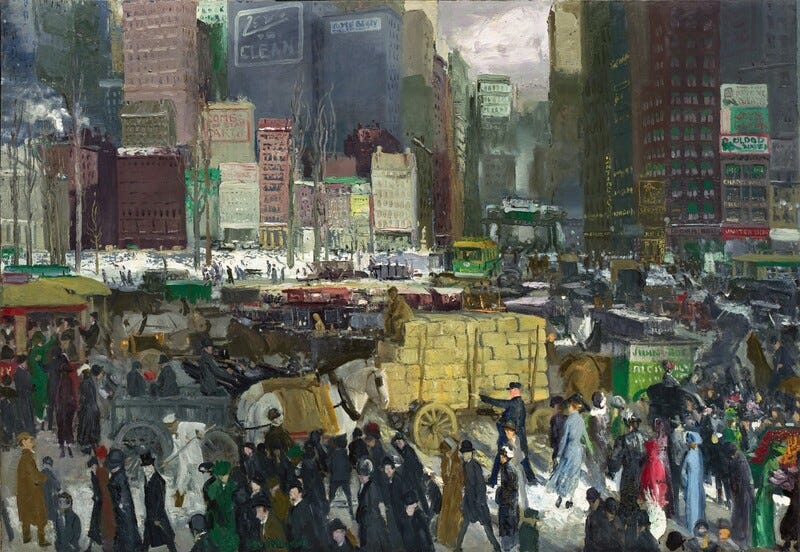 Sixth Avenue and Thirtieth Street, John Sloan (1908)
The city sharpens your perception and dulls your mercy in the same motion. You rarely get a clean answer; only a detail, a glance, a tight feeling in your stomach, and a decision you have to live with. Call it intuition if you want. Mostly it’s repetition. The doors open, the crowd shifts, the moment is gone, and you’re left holding whatever you chose to believe.
That’s the thesis, really. New York runs on reading. You learn to parse the difference between need and performance, between a story and the thing the story is meant to pry loose from you. You also learn, uncomfortably, that performance doesn’t automatically mean fraud. Sometimes, performance is the only language left for a person who has been ignored in plain speech. Sometimes it’s a tool of survival. Sometimes it’s a tool of power. The wealthy play this game too, often better, with nicer props and softer consequences. Everyone uses the same interface; the only difference is what failure costs.
Staying attentive becomes self-preservation, not because you’re cynical, but because you’re tired. Noticing is cheaper. Noticing is safer. Noticing also asks the ugliest follow-up question: once you’ve noticed, do you still want to feel?
This is where the transplant thought shows up, and I don’t like admitting it. On my worst days, I look at certain transplants and think, yeah, you don’t belong here. Not because the city is mine, and not because I think birthplace is a membership card. It’s something narrower and meaner: a reaction to the luxury of playing pretend, the ease of treating the city like a set. It’s when I’m tired, and the place feels like a closed system, like it only works if everyone understands the rules without needing them narrated. What I’m reacting to isn’t newcomers; it’s naivety, the kind that assumes consequences are optional and attention is a personal brand choice. That impulse isn’t admirable. It’s the sound of hardening resurfacing, the part of me that gets territorial about sidewalks, subways, and the unspoken etiquette of not making everything about yourself.
But the deeper claim isn’t about who gets to claim New York. It’s about what belonging actually is.
New York doesn’t ask to be loved. It asks to be survived. It doesn’t care about origin stories or sincerity or how carefully you explain yourself. It cares whether you can read a moment fast enough to stay upright inside it. Belonging isn’t permission; it’s endurance. It’s making a thousand small calls with incomplete information and paying for the ones you get wrong. You don’t get a clean answer. You get a detail, a glance, a tight feeling in your stomach, and then the city keeps moving.
New York doesn’t care where you’re from. It cares whether you look closer. And it collects the cost whether you consent or not.
